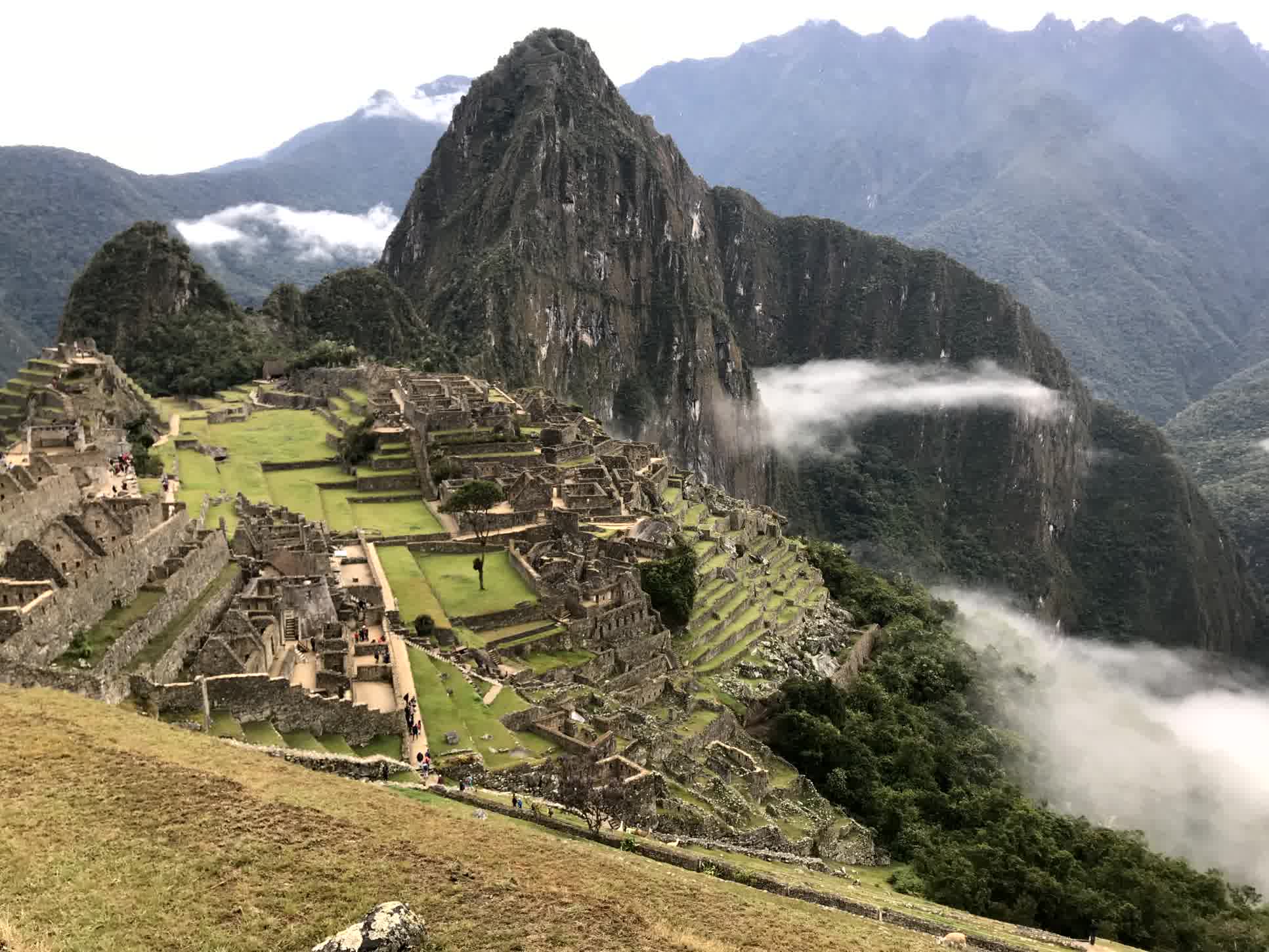
My visit to Machu Picchu was one of the most impactful and transformative I’ve even taken. This breathtaking Incan citadel is nestled high in the Andes Mountains of Peru, a marvel of ancient engineering, artistry, and spirituality. It’s located on the ridge of the Urubamba River. Rediscovered in 1911 by Hiram Bingham. In the Quechua language, Machu means “old” or “old person”, while pikchu means “pyramid; pointed, multi-sided solid; cone,” though it may also refer to a “portion of coca that is chewed.” Thus the name of the site is sometimes interpreted as “old mountain”. The site is on a narrow saddle between two mountain peaks: Machu Picchu and Huayna Picchu.
During its use as a royal estate, it is estimated that about 750 people lived there, with most serving as support staff who lived there permanently. Though the estate belonged to Pachacutec, religious specialists and temporary specialized workers lived there as well, most likely for the ruler’s well-being and enjoyment. During the harsher season, staffing was reduced to about one hundred servants and a few religious specialists focused on maintenance alone.
The site is divided into two main areas: the agricultural sector, comprising terraced fields that once grew crops, and the urban sector, which includes temples, residential buildings, and ceremonial spaces. The Temple of the Sun, the Room of the Three Windows, and the Intihuatana stone, an enigmatic ritual stone with astronomical significance, are among the most notable structures at the site. Machu Picchu holds immense cultural importance as a remnant of the Inca civilization.
Machu Picchu was built in the 15th century during the height of the Inca Empire, under the rule of the emperor Pachacuti Inca Yupanqui. It is believed to have served as a royal estate for the Inca emperor and a religious retreat. It is widely regarded as a sacred site due to its astronomical alignments and spiritual significance.
Since its rediscovery, Machu Picchu has become a UNESCO World Heritage Site and a symbol of Peru’s cultural heritage. Preservation efforts have been ongoing to protect the site from the impact of tourism and natural erosion. Visitor numbers are now regulated, and strict guidelines are in place to safeguard this fragile archaeological gem for future generations. Machu Picchu attracts hundreds of thousands of visitors annually, making it one of the most visited tourist destinations in the world.
I was in awe at the breathtaking vistas, the enigmatic history, and the sense of mystery that continue to draw people from all corners of the world. Machu Picchu stands as a testament to human ingenuity, cultural richness, and the enduring legacy of the Inca civilization, and I was touched by the mere sense of its history.